


After a summer break of the Debrief, this week’s issue is looking back at the last two months and the developments in the BHR field. Going forward, the newsletter’s format will change to a monthly issue, allowing for the contextualisation of BHR news within wider developments, providing a holistic picture and in-depth analysis to the reader.
This week, we look extensively at business and human rights in conflict-affected areas, including in the context of the Russian invasion of Ukraine and US tech company Ubiquiti which is sued over supplying material to Russia as well as Israel’s genocide in Gaza and illegal occupation of the Westbank and companies that are under increasing pressure to cut economic ties with Israel. Regarding deforestation, we examine new drivers of forest loss, such as the demand for wood pellets in Indonesia driving rainforest loss and charcoal production in Paraguay which drives deforestation in the Gran Chaco.
In the last section, we highlight new import ban legislation in Vietnam and in Taiwan, developed in the wake of the Section 301 investigation by the US Trade Representative. The US Department of Homeland Security has also added 43 entities to the Entity List of the UFLPA to ban imported goods made with Uyghur forced labour. Elsewhere, investigations in agricultural sectors across various countries have uncovered forced labour conditions, including in Costa Rica’s Coffee Industry, on Dominican sugarcane plantations and the Brazilian cotton sector.
If you'd like us to feature an upcoming event, report or other update on The Debrief, please don't hesitate to contact us via LinkedIn.
Announcements
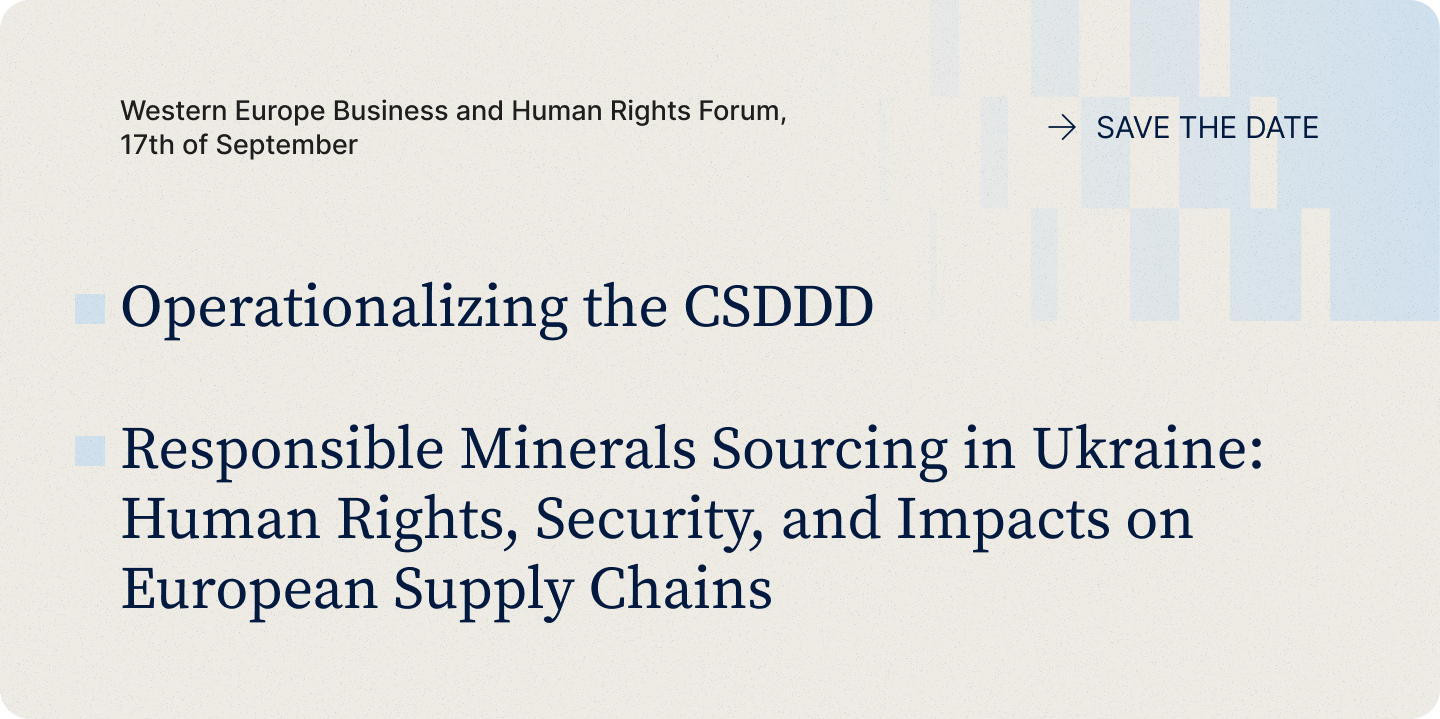
Session “Operationalizing the CSDDD”
Western Europe Business and Human Rights Forum, 17th of September
Beyond’s Due Diligence Lead, Dr. Claire Bright, will together with the Fair Labor Association host a panel on the operationalisation of the CSDDD. In a discussion with representatives from multi-stakeholder initiatives, international cooperations, legal experts and including Beyond’s Senior Advisor Anaïs Tobalagba, the speakers will dive into the details of the impending CSDDD implementation and enforcement. This will include aspects of meaningful rightsholder engagement, the roles of multi-stakeholder initiatives, collective action, the gender perspective, the role of contracts and purchasing practices as implementation measures and industry experiences.
Session “Responsible Minerals Sourcing in Ukraine: Human Rights, Security, and Impacts on European Supply Chains”
Western Europe Business and Human Rights Forum, 17th of September
Our sister organisation, Global Rights Compliance, will together with Swedwatch and UNDP host a session on Responsible Mineral Sourcing in Ukraine. The panel discussion will explore how Europe’s pursuit of secure and sustainable mineral supply chains can be aligned with responsible business conduct, Ukraine’s reconstruction and EU integration priorities, and the need to ensure that increased investment in the sector does not create or reinforce human rights abuses and environmental harms. The session will also consider the impact of Russia’s full-scale invasion, including the illegal exploitation and pillage of mineral resources in occupied territories, and the responsibilities of companies, investors, buyers and public authorities connected to conflict-affected supply chains.
→ Learn more here: Western Europe Business and Human Rights Forum
Due Diligence Legislation
Updates on BHR in conflict-affected areas:
The civil lawsuit is brought by Ukrainian families and filed by law firm DiCello Levitt against the US networking manufacturer Ubiquiti Inc. and alleges that the company is providing long-range wireless equipment central to the Russian drone campaign in its war on Ukraine.According to the lawyers, the wireless radio bridge antennas and the company’s airMAX technology connect drone pilots, reconnaissance feeds, commanders and attack units in real time and enable the killing of Ukrainian civilians.
The lawsuit comes after an investigation by Hunterbrook Media published earlier this year had exposed the continued exports of Ubiquiti material to Russia. Despite US and EU sanctions, the company shipments to Russia increased by 66% after the invasion, and include technology released after the ban. Products are often rerouted via third countries such as Türkiye and Kazakhstan.At the same time, Ubiquiti has not been charged by any EU or US authority with export-control violations or placed under sanctions. The company itself has admitted that it does not keep any visibility on the purchases from its distributors, a claim which legal experts maintain is not a viable defence.
Pressure on companies and governments mounts over complicity in human rights violations in Palestine.
Lynas Rare Earths, an Australian company extracting rare earth minerals in Malaysia, recently signed a US$96 million agreement with the U.S. Department of Defence. Because Malaysia is a long‑standing supporter of Palestine, this partnership with the U.S. drew significant criticism from political and civil society groups.As a result, Malaysia’sparliamentary special select committee on international relations and international trade examined the role of the agreement and recommended thatthe government more clearly define foreign investment policy to ensure national interests are protected.
The agreement, a binding letter of intent for a four-year supply deal, had previously been criticised by NGOs which argue that rare earth minerals mined in Malaysia should not contribute to violations of international humanitarian and human rights law. More than 20 NGOs joined the call for greater oversight of rare earth supply chains, arguing the agreement would contribute to US military support to Israel.
While this has shone a direct light onto Malaysian trade politics, itis a reflection of a wider discussion on trade in relation to the Occupied Palestinian Territories (OPT) and the war on Gaza. A recent report by Global Echo Litigation Center, shows that products from illegal settlements in the OPT are frequently exported to the EU using loopholes in trade agreements with Israel. Its investigation found that almost 20% of shipments destined for Europe containedgoodsproduced in settlements.
And in France, civil society actors recently sued the government for its failure to act on continued trade and thus, support for the Israeli occupation of the Palestinian Territories. The legal action, brought by five NGOs, draws on a 2024 advisory opinion by the International Court of Justice (ICJ) which found that the continued Israeli presence in the OPT is unlawful and that UN member states must take measures to prevent trade or investment relations that maintain the unlawful situation. The plaintiffs in the case brought against the French Prime Minister and several ministers of the cabinet outline that the occupation has been made possible not only by military means but also economic relationships and that states cannot comply with their obligations under international law as long as measures to prevent economic relationships are not passed.
Deforestation Legislation
Updates:
Indonesia’s Wood Pellet Supply Chains are threatening biodiversity and Indigenous Peoples.
New satellite analysis conducted by Earth Insight and Indonesian organisations Auriga Nusantara and AMAN shows that the surge in Indonesia's wood pellet and chip production is driving a new wave of deforestation, threatening the country's remaining tropical forests, biodiversity hotspots and Indigenous peoples' lands. Japan has become the biggest destination for Indonesian biomass exports, as the country expands wood-burning energy generation to meet its renewable energy targets, although it is intensely debated whether burning wood pellets contribute to a reduction in greenhouse gas emissions.
The investigation builds on earlier inquiries into South Korean demand for wood pellets from Indonesia which has collapsed following the exposed links to deforestation and tightening of laws. The effects of the boom threaten Indigenous Peoples, particularly on Sulawesi Island and biodiversity hotspots, including Orangutan habitats.
New investigation shows that charcoal sold in British stores has been produced on farms deforesting the Gran Chaco forest in Paraguay.
A new investigation by Global Witness uncovered that Paraguay’s largest charcoal exporting company, Taruma, supplies different brandsand supermarkets across the UK and is linked to deforestation. The analysis shows that the company buys large volumes of wood from cattle farms deep in the Gran Chaco forest.Paraguay’s second largest charcoal producer, Paben SA, is also driving deforestation, with satellite data showing significant destruction of forest in the last years, in parts facilitated by Paraguay’s weak environmental laws. Both these exporters are listed among the main suppliers to Big K, one of the most important UK charcoal companies.

Forced Labour Legislation
Updates:
Governments continue to advance legislation on import bans for products made with forced labour.
In Vietnam, the new legal ban on importing and exporting goods made wholly or in part with forced labour took effect on 5 September. Government ministers will be responsible for the development of detailed lists of goods prohibited from export and import and includes fines for individuals and organisations that lure, entice or deceive workers for the purpose of exploitation or forced labour. Importers will need to provide proof of origin for inputs of their products along the list of goods published by the ministries.
In Taiwan, a new cross-agency mechanism established by the Ministry of Economic Affairs and the Ministry of Labour aims to block goods linked to forced labour from entering the country. Under the mechanism, a 12-member inter-agency committee will review cases referred by partner countries and must reach a decision within 30 days, assessing whether goods meet any of the ILO's 11 indicators of forced labour and whether the company concerned has taken corrective action. While the country has stressed it will pursue its own investigations into forced labour, the mechanism is currently reactionary, relying on partner countries’ findings.
The US has added 43 new entities to the entity list banning their imports over alleged rights abuses of Uyghur and other ethnic minority groups.
The companies were added to the Uyghur Forced Labor Prevention Act Entity List, bringing the number of listed corporations from 144 to 187 in the largest single expansion since its inception. Four companies were listed due to their alleged cooperation with Xinjiang authorities to recruit, transfer and receive Uyghurs and other persecuted groups. Other actors were added due to their sourcing of materials from entities in Xinjiang that are linked to government labour programmes in the region. The listed companies include suppliers of aluminium, apparel, copper, cotton, tomatoes and their downstream products.
Investigations across Latin American countries have uncovered forced labour across agricultural sectors.
In Costa Rica, a new investigation by Coffee Watch exposes extensive human rights abuses in the Costa Rican coffee sector. Particularly migrant workers, primarily Indigenous Ngäbe-Buglé families from Panama, face dangerous working conditions, poverty wages, overtime, child labour and systematic exclusion from legal protections which in turn lead to poor living conditions. These realities are embedded in long-standing patterns of racialized labour and structural inequalities concerning migrant labour while at the same time, around 70% of all coffee work is performed by foreign workers. Due to the structure of the workforce, its seasonality and legal restrictions on foreign union leaders, there is little support for farmworkers to demand better conditions.
An investigation into the Dominican sugar sector and the largest employer and landowner in the Dominican Republic, Central Romana, has uncovered conditions that reasonably indicate the use of forced labour on plantations. The Corporate Accountability Lab, which undertook the investigation over three years, details that Haitian migrants and Dominicans of Haitian descent, who constitute the majority of sugarcane cutters, are systematically exploited. Workers described living in extreme poverty under surveillance and fear on the plantations of Central Romana, facing structural discrimination and anti-Haitianism, abuse by guards, and a lack of representation through unions. The US Customs and Border Protection had blocked goods from the company to be imported in 2022, a step reversed under the Trump administration. Central Romana’s owners, the Fanjul family, has donated millions for the Trump campaign and has close ties to the administration.
In Brazil, Ministry of Labour inspectors uncovered that workers were subjected to conditions analogous to slavery in the cotton sector at a grower in Mato Grosso. The company who owns the farm where workers were freed, Grupo Cervi, is a longstanding supplier to the US multinational company Bunge which sells cotton to major fashion brands across the globe. Workers were housed in overcrowded containers, in enclosed areas, under constant surveillance, and showed signs of poisoning from pesticides used in cotton fields.
❕ Disclaimer: This newsletter is for general informational purposes only. It does not, and is not intended to, constitute legal advice.